



















Description
In June 1959 British Railways ordered 45 diesel-hydraulic locomotives for the Western Region, adding 50 more in 1960 and a final six in 1961 to make a class of 101. Styled with input from Wilkes and Ashmore, the team also behind the 'Falcon' and 'Lion' prototypes and the Class 47, the Hymek was the only one of the four main diesel-hydraulic classes built by an outside firm: Beyer, Peacock & Co. at Gorton Works, Manchester. Power came from a Bristol Siddeley-built Maybach MD870 engine driving through a Mekydro hydro-mechanical transmission, which gave the class its nickname.
D7000 was handed over at Paddington on 16 May 1961, three months early. Early locos worked from Bristol Bath Road, but with the Westerns running late many were sent to South Wales, which is why most from D7034 onwards gained headboard clips for named trains. From 1963 the Hymeks became synonymous with Hereford to Paddington services, and they ranged across the Western Region from West London to the West Country, South Wales and the West Midlands, as well as Waterloo to Exeter, Weymouth, Bournemouth and other Southern routes. From 1967 five were based at Worcester to bank trains up the Lickey Incline.
Withdrawals began in September 1971, and the class may have been the first diesels to get a farewell railtour, on 22 September 1973. D7017 and D7018 were the last in service, withdrawn in March 1975. Four survive: D7017 and D7018 on the West Somerset Railway, D7029 with the Diesel Traction Group on the Severn Valley Railway, and D7076 with the Bury Hydraulic Group on the East Lancashire Railway.
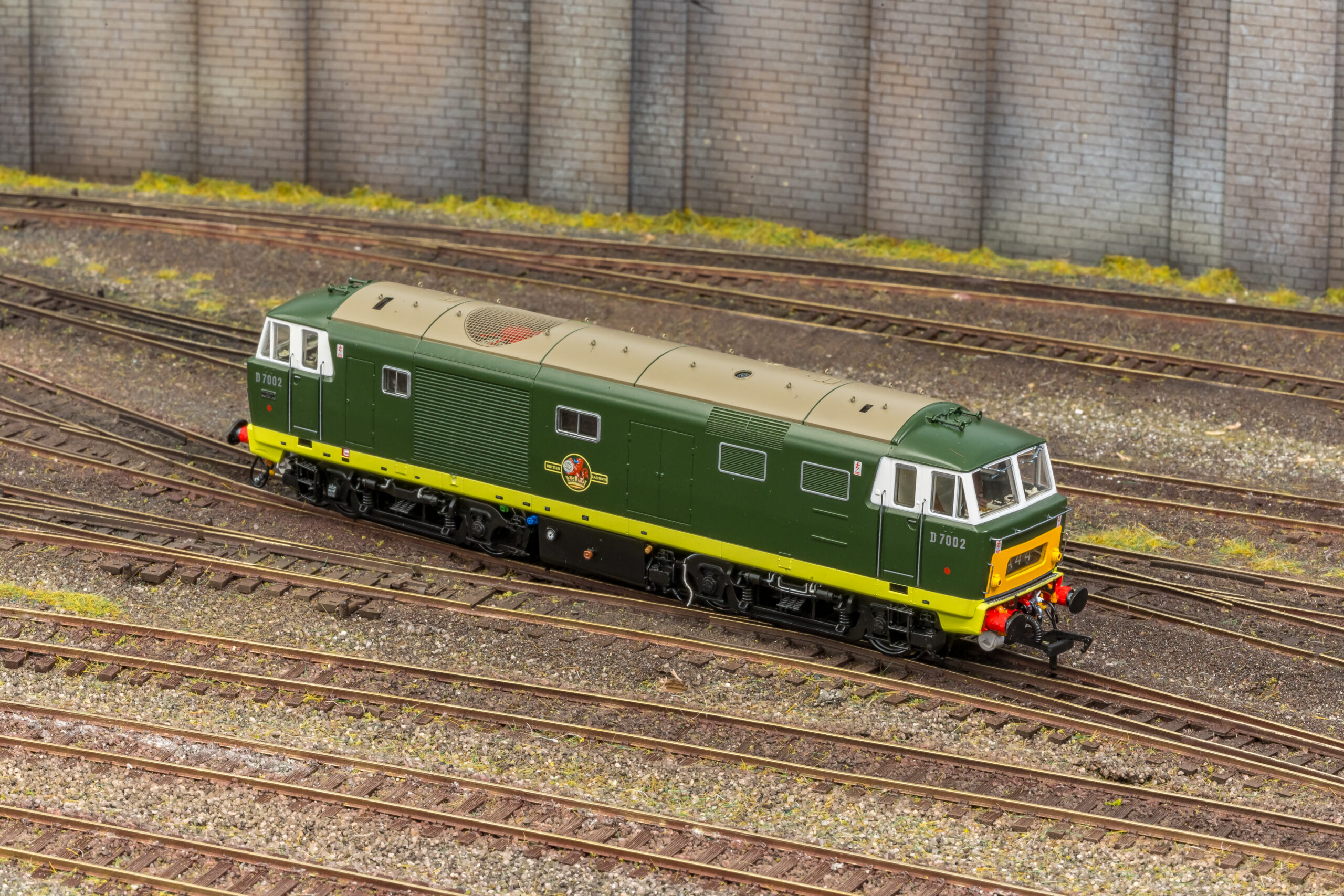
Rapido Trains UK's first mainline diesel in OO gauge combines a diecast metal chassis with an injection-moulded body. Tooling variations cover the different boiler room roofs, sandboxes, bogie-mounted brake cylinders, lower cab door handles and headboard clips, so each loco matches its chosen period. Every model has etched fan grilles, see-through cab steps, fully detailed bogies, fuel tanks and underside detail. Directional and cab lights can be controlled through DCC or, on DC, switched with the supplied magnetic wand, and the headcode panel can be swapped for any of the 14 included. A full-colour 3D-printed driver and secondman by Modelu are included, with uniforms to suit the model's era, along with extra buffer beam detail, snowploughs, an etch of cabside numbers and plates, a loco history card, a DCC function card and an art print.
This version: D7002 in BR Green with small yellow panels, DCC Ready. Period details: no lower cab door handles, no headboard clips, Stone-Vapor boiler room roof, early sandboxes, conical-end brake cylinders.
Features include:
• No lower cab door handles
• No headboard clips
• Stone-Vapor boiler room roof
• Early sandboxes
• Conical-end brake cylinders
• Directional lighting
• Cab lighting
• 21-pin decoder socket
• High-quality 5-pole motor and drive mechanism for smooth running
• Factory-fitted passive radiator speaker & smoke unit in all models
• Dynamic exhaust effect on DCC sound models (ESU LokSound 5)
• MoPower stay-alive
• Kinematic NEM 362 coupler pockets
• Easily changeable headcodes with 14 different versions included
• Separately fitted wipers
• Etch fret with full set of number and works plates
• Pre-fitted ‘cut off’ buffer beam detailing to work when coupler fitted
• Optional ‘full’ buffer beam detailing to fit as required
• 3D colour-printed crew with steam-era style uniforms
• Colour art print of locomotive on Dawlish sea wall
• Separately fitted radiator fan grille (working fan on DCC sound models)
DCC: DCC Ready with a 21-pin decoder socket and MoPower stay-alive. The passive radiator speaker and smoke unit are already fitted, so the loco can be upgraded later with an ESU LokSound 5 decoder loaded with Rapido's Hymek profile (available from Rapido) to add sound and the dynamic exhaust effect. The smoke effect needs ESU 51990 Smoke Distillate, sold separately.
Images are pre-production renders or samples and the finished model may differ.